.svg)


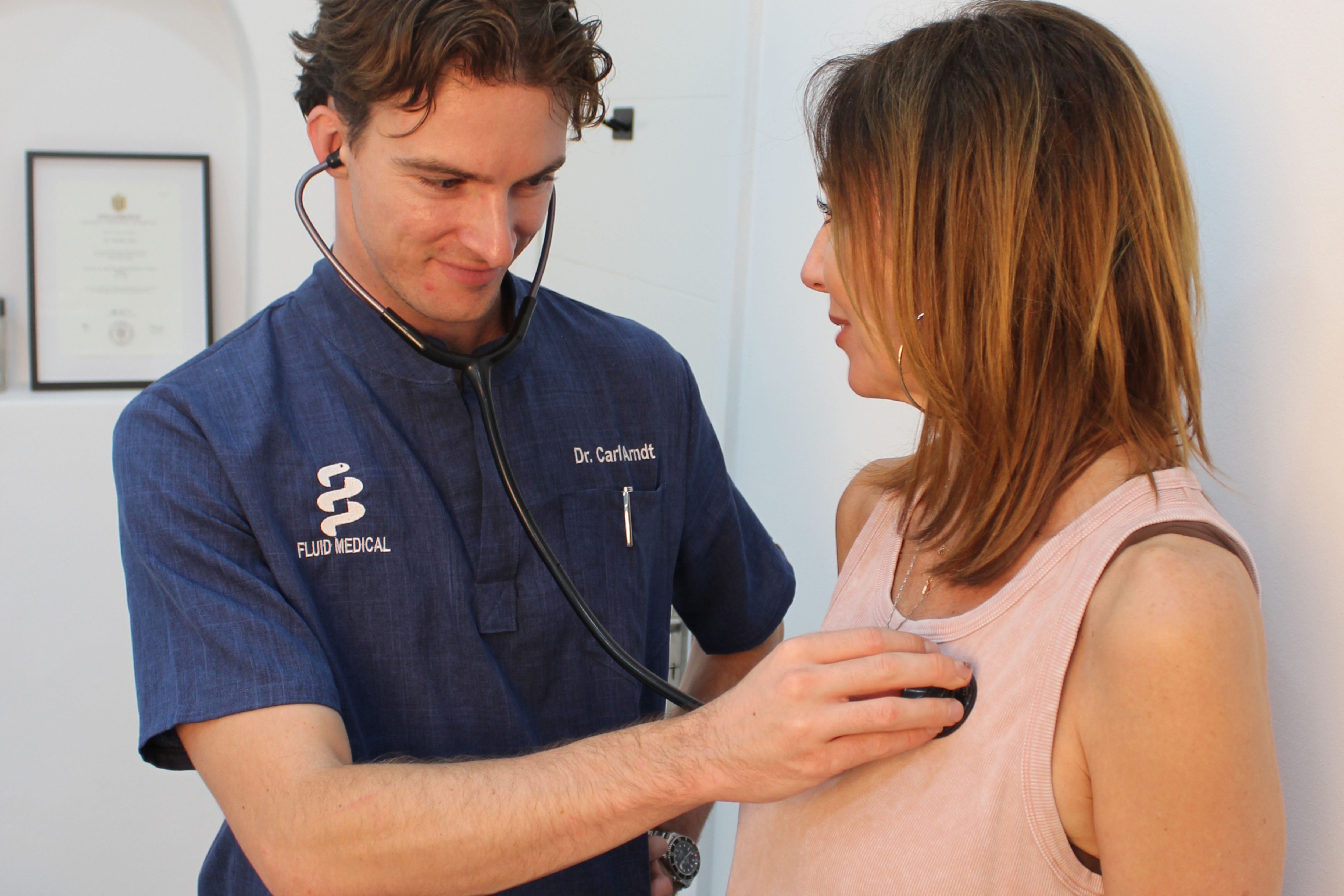
Fluid Medical's doctors do house calls at night across the greater Cape Town area, to your home or hotel, for urgent, non-life-threatening problems such as an infection, dehydration or a familiar migraine. Availability is confirmed when you book. For chest pain, stroke signs, severe breathlessness or collapse, call an ambulance on 10177, or 112 from a cellphone [1].
The service is a doctor-led 24/7 house call that brings a structured GP assessment to your bedside, but it is not an emergency service.
At a glance
- A house call may suit urgent, non-life-threatening illness when you are too unwell to travel.
- A possible heart attack, stroke, collapse or major injury needs emergency care, not a call-out.
- Mild symptoms that do not need an examination may be manageable with a tele-consult.
Is There a Doctor That Does House Calls at Night in Cape Town?
Yes. Fluid Medical offers a 24-hour, seven-day private doctor home visit service across the greater Cape Town area for urgent but non-life-threatening conditions, with availability confirmed when you book.
The visiting general practitioner (GP) follows the same structured assessment as at the medical centre. It can suit people who are too unwell to travel, less mobile or who prefer discreet care at home.
Can a Doctor Come to My Hotel in Cape Town?
A doctor call-out can be booked to your hotel as well as your home if you fall ill while visiting, with availability confirmed when you book.
When Should You Call an Ambulance Instead of a Doctor?
Call an ambulance, not a house-call doctor, for anything that could be life-threatening. The Western Cape Government lists 10177 as the National Medical Emergency Number, and you can dial 112 from a cellphone [1].
If you are unsure, call anyway rather than waiting for a house call.
Red Flags That Need Emergency Care Now
Call 10177 or 112 straight away for:
- Chest pain, pressure, tightness or heaviness, whether or not it spreads to the arm, neck, jaw or upper abdomen
- Sudden stroke signs, such as a drooping face, arm or leg weakness, slurred speech, or loss of balance or vision
- A sudden, severe headache unlike any you have had before
- Severe difficulty breathing, collapse, or someone who cannot be woken
- A seizure (fit) lasting more than five minutes, or repeated seizures without waking in between
- A severe allergic reaction, with throat swelling, wheezing or feeling faint
- Major trauma, or bleeding that will not stop
- A child who is struggling to breathe, will not wake, or has a fever with a rash that does not fade when pressed
The UK's National Institute for Health and Care Excellence (NICE) fever guidance [2] treats those signs in a child as high risk, and South Africa's primary healthcare Standard Treatment Guidelines [3] list a heart attack, anaphylaxis (a severe allergic reaction) and prolonged seizures as emergencies.
The 2021 US chest pain guideline from the American Heart Association and American College of Cardiology [4] advises calling an ambulance for acute chest pain rather than making your own way to hospital. It notes that chest pain is the most common symptom of a heart attack in women as well as men, although women more often also have nausea, palpitations or breathlessness.
How Can You Spot a Stroke?
The FAST check (Face drooping, Arm weakness, Speech difficulty, Time to call) can miss strokes. A 2017 review of 736 patients with ischaemic stroke (caused by a blocked blood vessel) at one US stroke centre, published in Stroke [5], found that 14.1% had none of these signs. Adding balance problems and eye (vision) symptoms, known as BE-FAST, reduced the proportion missed to 4.4%.
BE-FAST is a memory aid, not a diagnostic test, so sudden confusion or loss of balance or vision still needs an ambulance.
Emergency Numbers to Save
- 10177: the National Medical Emergency Number for an ambulance [1]
- 112: the emergency number from a cellphone [1]
- 021 480 7700 from any phone, or 107 from a landline: the City of Cape Town emergency line [6]
When you call, the City of Cape Town advises giving your name and number first, an exact location and any existing conditions, such as diabetes [6].
Should You Go to Casualty Instead?
If you can travel safely but may need an X-ray, a scan or hospital tests, a 24-hour emergency unit (casualty) may be more appropriate than a call-out. The Western Cape Government lists 24-hour emergency care facilities for people able to travel [1].
A head injury is one example, because a brain scan cannot be done at home. UK NICE guidance [7] recommends that GPs refer people to an emergency department, by ambulance if necessary, when risk factors are present, including loss of consciousness, drowsiness or confusion, new weakness, memory loss, a persistent headache, vomiting or a seizure since the injury, or use of blood-thinning medication other than aspirin alone. In these situations, go straight to an emergency unit.
What Can a GP Do at a Home Visit?
At a Fluid Medical home visit, the doctor takes a detailed medical history, examines you, makes a clinical diagnosis and gives you a treatment plan with follow-up advice.
Depending on your symptoms, the doctor may take blood, test a urine sample, run point-of-care tests (rapid tests done at the bedside rather than in a laboratory) or use a portable ultrasound scanner. When clinically appropriate, the doctor can give intravenous (IV) fluids, IV or intramuscular medication, nebulisation (medication breathed in as a fine mist), wound care and symptom-directed injections.
Not everyone who is dehydrated needs a drip, which is why an IV drip should always be a doctor's clinical decision based on your assessment and, where appropriate, your blood results.
Which Night-Time Problems Can a House Call Handle?
A house call may be appropriate for urgent problems that are not immediately dangerous, such as a respiratory, stomach or urinary infection, dehydration from vomiting or diarrhoea, a familiar migraine, an episode of acute pain, a flare-up of a long-term condition or a review after an operation.
If any of these come with severe breathlessness, chest pain, new confusion or collapse, call an ambulance instead. If hospital care is needed, the doctor will advise you.
A House Call for an Elderly Parent
A home visit lets a frail or less mobile parent be examined in familiar surroundings, without a difficult journey at night. If they live with a long-term illness, it may help to follow the visit with structured long-term management of conditions such as heart failure, chronic obstructive pulmonary disease (COPD) and type 2 diabetes once the acute episode has settled.
Is a Tele-Consult Enough, or Do You Need a Doctor in Person?
A tele-consult may be enough for mild symptoms that do not need an examination. If you need to be examined, have tests or receive a drip or injection, a house call or a visit to the medical centre is more appropriate.
Fluid Medical's secure video tele-consult for milder symptoms such as a cold, gastroenteritis or an uncomplicated urinary tract infection is also offered 24/7, subject to availability.
A 2022 guide in South African Family Practice [8], based on the Health Professions Council of South Africa's Booklet 10, states that telehealth is not a substitute for physical consultations, and that a patient who looks or sounds acutely ill should be seen in person or referred.
How Can You Prepare While You Wait for the Doctor?
Before the doctor arrives, gather a list of current medicines and allergies, note when symptoms started and make sure the doctor can find and reach your door. If symptoms worsen while you wait, call an ambulance straight away.
It also helps to have:
- Recent test results or discharge letters
- Access details for the gate or intercom
- Outside lights on and pets secured
What Happens After a Night-Time House Call?
You should leave the visit with a working diagnosis, a treatment plan and clear advice on what to watch for. Follow-up can continue by tele-consult or in person, so your care does not start over.
If you notice tiredness that lingers for weeks after an illness, which can have several medical causes worth exploring properly, consider booking a follow-up assessment.
Book a Doctor-Led 24/7 House Call in Cape Town
For an urgent but non-life-threatening problem after hours, you can book a doctor-led house call or tele-consult through Fluid Medical's online booking system, phone 021 200 2121 or WhatsApp 076 577 9287. Availability is confirmed when you book.
Fluid Medical is a doctor-led, multidisciplinary medical centre at 22 Hope Street, Gardens, with doctors across General Healthcare for Men & Women, Preventative & Longevity Medicine, Aesthetics Treatments and Sports & Exercise Medicine under one roof.
When you are feeling better, you can arrange an unrushed, in-depth follow-up consultation at the medical centre.
If it could be an emergency, do not wait for a call-out. Call 10177, or 112 from a cellphone.
This article is general health information and does not replace a consultation with a doctor.
References
- Western Cape Government. Accessing health services [Internet]. Cape Town: Western Cape Government; [cited 2026 Sep 14]. Available from: https://www.westerncape.gov.za/health-wellness/service/accessing-health-services
- National Institute for Health and Care Excellence. Fever in under 5s: assessment and initial management. NICE guideline [NG143]. London: NICE; 2019 Nov 7 [updated 2021 Nov 26; cited 2026 Sep 14]. Available from: https://www.nice.org.uk/guidance/ng143/chapter/Recommendations
- National Department of Health (South Africa). Primary healthcare standard treatment guidelines and essential medicines list. Chapter 21: Emergencies and injuries. 2020-4 review, version 1.0. Pretoria: National Department of Health; 2024 Jul 1 [cited 2026 Sep 14]. Available from: https://www.health.gov.za/wp-content/uploads/2024/07/PHC-Chp-21_Emerg-and-Injruies-and-supporting-NEMLC-report-and-reviews_2020-4_Version-1.0_1-July-2024.pdf
- Gulati M, Levy PD, Mukherjee D, Amsterdam E, Bhatt DL, Birtcher KK, et al. 2021 AHA/ACC/ASE/CHEST/SAEM/SCCT/SCMR guideline for the evaluation and diagnosis of chest pain: a report of the American College of Cardiology/American Heart Association Joint Committee on Clinical Practice Guidelines. Circulation. 2021;144(22):e368-e454. doi:10.1161/CIR.0000000000001029. Available from: https://pubmed.ncbi.nlm.nih.gov/34709879/
- Aroor S, Singh R, Goldstein LB. BE-FAST (Balance, Eyes, Face, Arm, Speech, Time): reducing the proportion of strokes missed using the FAST mnemonic. Stroke. 2017;48(2):479-81. doi:10.1161/STROKEAHA.116.015169. Available from: https://pubmed.ncbi.nlm.nih.gov/28082668/
- City of Cape Town. 107 emergency contacts pamphlet (Eng/Afr/Xhosa) [Internet]. Cape Town: City of Cape Town; [updated 2025 Mar 18; cited 2026 Sep 14]. Available from: https://www.capetown.gov.za/_documents/resource.capetown.gov.za/documentcentre/Documents/Graphics%20and%20educational%20material/107_brochure_2015.pdf
- National Institute for Health and Care Excellence. Head injury: assessment and early management. NICE guideline [NG232]. London: NICE; 2023 May 18 [cited 2026 Sep 14]. Available from: https://www.nice.org.uk/guidance/ng232/chapter/Recommendations
- Rabe M. Telehealth in South Africa: a guide for healthcare practitioners in primary care. S Afr Fam Pract (2004). 2022;64(1):e1-e6. doi:10.4102/safp.v64i1.5533. Available from: https://pmc.ncbi.nlm.nih.gov/articles/PMC9257714/
Article Author

.svg)
.svg)
.svg)