.svg)


If antiperspirant isn't controlling your sweating, you may have hyperhidrosis, the medical name for excessive sweating beyond what your body needs to stay cool. A doctor can first check for an underlying cause, then discuss options such as stronger aluminium chloride antiperspirants or botulinum toxin injections, which can reduce underarm sweating for several months.
Many people notice it most in Cape Town's hot summer months, but it is a medical condition, not a hygiene problem. At Fluid Medical, a clinical assessment comes first and, where suitable, may lead to doctor-administered injections that calm overactive sweat glands in the underarms.
At a glance
- In a US dermatology study of 415 patients, most excessive sweating was primary hyperhidrosis, but some patterns need a medical check first.
- Stronger antiperspirants usually come first; muscle-relaxing injections are an option when they aren't enough.
- Injection results commonly last several months, then fade, so treatment is repeated.
What Is Hyperhidrosis?
Hyperhidrosis is sweating beyond what your body needs for temperature control, most often in the underarms, palms, soles or face. A 2016 US online survey published in Archives of Dermatological Research estimated that 4.8% of people in the US have it, but only 51% had discussed it with a healthcare professional [1].
Primary Hyperhidrosis
Primary (focal) hyperhidrosis isn't caused by another condition and often runs in families. Its cause isn't fully understood, but it is thought to involve overactive nerve signals to eccrine sweat glands, the body's main temperature-regulating sweat glands [2].
When sweating has lasted six months or more, doctors look for features such as sweating on both sides, episodes at least weekly, onset at age 25 or younger, no sweating during sleep, a family history and an impact on daily life [3]. These are clinical clues, not a self-test.
Secondary Hyperhidrosis
Secondary hyperhidrosis is caused by another medical condition or a medicine, and can affect one area or the whole body [2].
Is Excessive Sweating a Sign of Something Serious?
Excessive sweating is often not a sign of something serious. In a review of 415 patients at one US university dermatology department, published in the Journal of the American Academy of Dermatology, 93% had primary hyperhidrosis [3].
Sweating that began after age 25, affected one side, involved the whole body or happened at night made an underlying cause more likely. Among the 28 secondary cases, hormone-related conditions, mainly diabetes and an overactive thyroid, accounted for 57% [3]. Infection, menopause, low blood sugar, heart and lung conditions, anxiety and some medicines can also cause it [2].
Sweating Patterns a Doctor Should Check
Whether or not you're considering treatment, see a doctor if your sweating:
- Happens at night, affects your whole body or only one side
- Started after about age 25, after a new medicine, or changed suddenly
- Comes with fever, unexplained weight loss or feeling unwell
- Comes with shakiness, which can signal low blood sugar
- Began with hot flushes around menopause
Several of these conditions also feature in a guide to persistent tiredness that doesn't lift after sleep and its possible medical causes.
Never stop a prescribed medicine without speaking to your doctor. Sudden sweating with chest pain, breathlessness, nausea, light-headedness, confusion or fainting needs emergency care: call 10177, or 112 from a mobile.
What a Medical Assessment May Involve
A doctor will review your sweating, health and medicines, examine you and order blood tests only when needed. This can be done through an in-depth medical consultation that looks at thyroid, blood sugar and medication-related causes. Because Fluid Medical is a multidisciplinary medical centre, its General Healthcare doctors can assess a possible cause before any treatment is planned in Aesthetics.
Why Isn't Your Antiperspirant Working?
Everyday antiperspirant may not be strong enough for hyperhidrosis. Unlike deodorants, antiperspirants contain aluminium salts that reduce the sweat reaching your skin [2].
To get more from it:
- Apply it at night to clean, dry skin; primary sweating usually settles during sleep [3], giving it time to work.
- Try an over-the-counter "clinical strength" product, which can reduce sweating with less irritation than stronger aluminium chloride solutions [2].
What Treatments Can a Doctor Offer for Excessive Sweating?
Recommendations from the Canadian Hyperhidrosis Advisory Committee, published in Dermatologic Surgery, suggest topical aluminium chloride first for mild sweating, then botulinum toxin injections; in severe cases, both are first-line options [4].
Stronger Aluminium Chloride Antiperspirants
Higher-strength aluminium chloride products are usually applied at night for six to eight hours, then less often once sweating is controlled [2]. They are sold through pharmacies but can irritate the skin [2], so ask your doctor or pharmacist how to use them.
Botulinum Toxin Injections for Underarm Sweating
Botulinum toxin is a purified protein that temporarily blocks the nerve signals that switch sweat glands on. In South Africa it is a Schedule 4, prescription-only medicine [5], so treatment should follow a doctor's assessment.
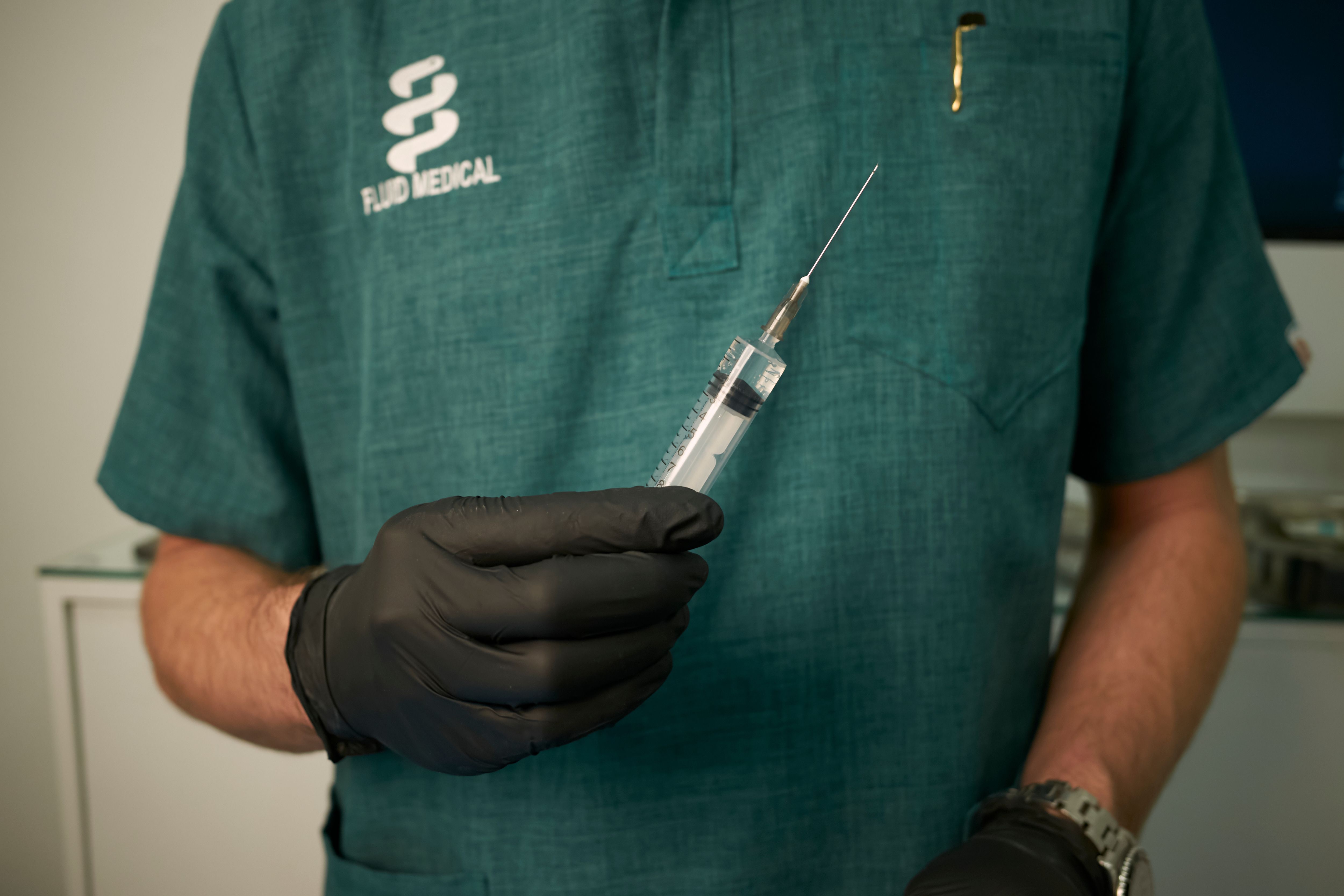
At Fluid Medical, a doctor maps the underarm and places very small amounts just beneath the skin with a fine needle. Read more about how botulinum toxin works on nerves, muscles and sweat glands across medicine.
Other Options Your Doctor May Discuss or Refer For
- Iontophoresis: a mild electrical current passed through water while the hands or feet are immersed [2].
- Anticholinergic tablets: medicines that block the nerve signals to sweat glands; dry mouth, blurred vision and constipation can occur [2].
- Surgery: removing underarm sweat glands, or cutting nerves in the chest for hands and feet, only after other options fail [4]; the chest operation commonly causes sweating elsewhere [2].
How Long Do Injections for Underarm Sweating Last?
Results usually begin within a few days to two weeks and last several months before sweating returns. In a 52-week trial of 322 people with severe underarm sweating, published in the Journal of the American Academy of Dermatology, the median effect lasted 197 to 205 days, roughly six and a half months, compared with 96 days on placebo [6].
A median means about half of people had a shorter effect. Fluid Medical's own guidance gives a typical range of four to six months, sometimes longer, and results vary.
How Well Do the Injections Work?
In a randomised, placebo-controlled trial of 320 people published in the BMJ, 94% of treated patients had at least halved their underarm sweat at four weeks, compared with 36% on placebo. At 16 weeks, the figures were 82% and 21% [7].
Treatment-related side effects were reported by 11% of treated patients and 5% on placebo, a difference that was not statistically significant; most adverse events were mild or moderate [7]. Injection-site pain and bruising are the usual side effects [2].
These are trial results, not a promise; the aim is less sweating, not completely dry skin.
Will You Sweat More Elsewhere Afterwards?
This appears to be uncommon after injections. In the BMJ trial, 5% of treated patients felt they sweated more elsewhere [7], and a small British Journal of Dermatology study of 17 people found no significant increase in untreated skin areas up to six months after palm injections [8].
Does Sweating Treatment Hurt, and Can Palms Be Treated?
You can expect brief discomfort as the injections are given, and a numbing cream can be applied beforehand. Palms and feet are more sensitive, and sweating there is assessed individually at consultation.
There is little to no downtime, although your doctor may advise waiting a day or two before strenuous exercise. A follow-up review is offered to check the result.
Tell your doctor if you are pregnant or breastfeeding, or have a nerve or muscle condition.
Sweaty Palms and Feet
Sweaty palms and feet can be treated, usually starting with stronger aluminium chloride antiperspirants. The Canadian recommendations add injections or iontophoresis if needed, with iontophoresis first-line when sweating is severe [4]. Palm injections can be more uncomfortable, may bruise and can temporarily weaken grip [2].
Book a Doctor-Led Excessive Sweating Assessment in Cape Town
A doctor can help work out what is behind your sweating and which options may suit you.
Fluid Medical is a doctor-led, multidisciplinary medical centre in Gardens, with doctors across General Healthcare for Men & Women, Aesthetics Treatments, Preventative & Longevity Medicine, and Sports & Exercise Medicine under one roof, so your care doesn't start over every visit.
If any of the warning signs above apply, start with a standard medical consultation. If your sweating is long-standing and mainly underarm, begin with a free 30-minute doctor's consultation to assess your sweating and discuss suitable options. If a medical cause needs looking into, your doctor will tell you at the time, and normal consultation fees then apply.
You can book your appointment online with Fluid Medical in Gardens, Cape Town, call 021 200 2121 or WhatsApp 076 577 9287. All treatment is subject to individual clinical assessment.
This article is general health information and does not replace a consultation with a doctor.
References
- Doolittle J, Walker P, Mills T, Thurston J. Hyperhidrosis: an update on prevalence and severity in the United States. Arch Dermatol Res. 2016;308(10):743-9. doi:10.1007/s00403-016-1697-9. https://pubmed.ncbi.nlm.nih.gov/27744497/
- McConaghy JR, Fosselman D. Hyperhidrosis: management options. Am Fam Physician. 2018;97(11):729-34. PMID: 30215934. https://www.aafp.org/afp/2018/0601/p729
- Walling HW. Clinical differentiation of primary from secondary hyperhidrosis. J Am Acad Dermatol. 2011;64(4):690-5. doi:10.1016/j.jaad.2010.03.013. https://pubmed.ncbi.nlm.nih.gov/21334095/
- Solish N, Bertucci V, Dansereau A, Hong HC, Lynde C, Lupin M, et al. A comprehensive approach to the recognition, diagnosis, and severity-based treatment of focal hyperhidrosis: recommendations of the Canadian Hyperhidrosis Advisory Committee. Dermatol Surg. 2007;33(8):908-23. doi:10.1111/j.1524-4725.2007.33192.x. https://pubmed.ncbi.nlm.nih.gov/17661933/
- South African Health Products Regulatory Authority. Medicines and Related Substances Act, 1965 (Act 101 of 1965): consolidated schedules, 1 August 2025 [Internet]. Pretoria: SAHPRA; 2025 [cited 2026 Sep 14]. https://sahpra.org.za/wp-content/uploads/2025/08/Consolidated-Schedules_01-August-2025.pdf
- Lowe NJ, Glaser DA, Eadie N, Daggett S, Kowalski JW, Lai PY. Botulinum toxin type A in the treatment of primary axillary hyperhidrosis: a 52-week multicenter double-blind, randomized, placebo-controlled study of efficacy and safety. J Am Acad Dermatol. 2007;56(4):604-11. doi:10.1016/j.jaad.2007.01.009. https://pubmed.ncbi.nlm.nih.gov/17306417/
- Naumann M, Lowe NJ. Botulinum toxin type A in treatment of bilateral primary axillary hyperhidrosis: randomised, parallel group, double blind, placebo controlled trial. BMJ. 2001;323(7313):596-9. doi:10.1136/bmj.323.7313.596. https://pubmed.ncbi.nlm.nih.gov/11557704/
- Krogstad AL, Skymne A, Pegenius G, Elam M, Wallin BG. No compensatory sweating after botulinum toxin treatment of palmar hyperhidrosis. Br J Dermatol. 2005;152(2):329-33. doi:10.1111/j.1365-2133.2004.06255.x. https://pubmed.ncbi.nlm.nih.gov/15727647/
Article Author

.svg)
.svg)
.svg)