.svg)


One minute, you are cruising through your usual route. The playlist is doing its job, your pace feels good, and you are already mentally adding another kilometre. Then something starts to hurt.
Maybe it is your knee. Maybe your shin has developed a suspicious little ache. Or perhaps your Achilles suddenly feels like it has lodged a formal complaint.
For runners, knowing what to do next is not always obvious. Some aches settle with rest and a sensible adjustment to training. Others are signs of sports and exercise-related injuries that deserve medical attention. The tricky part is knowing which is which.
Running through every niggle is not a badge of honour. Neither is assuming every stiff calf means your running shoes need to be retired immediately. Here is how to make a more sensible call.
Why Do Running Injuries Happen?
Running asks your body to absorb and manage repeated loads, kilometre after kilometre. Your muscles, tendons, joints and bones adapt to that workload over time, but problems can develop when the demands of training exceed what your body is currently prepared to handle.
This is why sports and exercise-related injuries often appear after something changes. You have increased your weekly distance and added hill sessions. Started speed work. Returned after a long break. Changed your running surface. Or signed up for a race and suddenly decided that your previously casual relationship with running needs to become very serious indeed.
Common sports and exercise-related injuries among runners include:
- Muscle strains
- Ankle sprains
- Achilles tendon problems
- Shin pain or shin splints
- Plantar fasciitis and heel pain
- Runner's knee
- Iliotibial band-related pain
- Stress reactions and stress fractures
- Hip, knee, ankle and foot injuries
Fluid Medical assesses a range of acute and ongoing sports and exercise-related injuries, including muscle strains, ligament sprains, tendon problems, stress injuries and running-related shin pain.
When Is Rest Probably the Right First Step?
Not every post-run ache needs an appointment.
Muscle soreness after a harder-than-usual workout can be a normal response to training. If both legs feel generally stiff or tired, the discomfort is mild, and you can walk normally, taking a recovery day may be reasonable.
Rest does not necessarily mean becoming one with the sofa for the foreseeable future. It means reducing the activity that is aggravating the problem and giving your body an opportunity to recover.
If you notice mild discomfort, consider:
- Skipping your next run or reducing your training load.
- Avoiding hills, speed sessions or long runs temporarily.
- Paying attention to whether normal walking causes pain.
- Checking whether swelling, bruising or redness develops.
- Noting whether the discomfort improves, stays the same or worsens over the next few days.
- Avoiding the temptation to repeatedly "test" the injury with another hard run.
This last one catches runners out surprisingly often. Taking two days off and then attempting your fastest 10 km to "see if it is better" is not much of a recovery strategy.
For mild sports and exercise-related injuries, temporarily modifying activity may be enough. But pain that keeps returning whenever you run deserves closer attention.
What Pain Should Runners Not Ignore?
Pain is information. You do not need to panic every time something feels uncomfortable, but certain changes should make you stop and reassess.
The American Orthopaedic Society for Sports Medicine lists pain while running, pain at rest, limping, stiffness, difficulty sleeping because of discomfort, dizziness and headaches among signs that runners may need to stop or alter their running.
A useful distinction is whether the discomfort is simply present or whether it is changing how you move. If you are limping, shortening your stride or shifting your weight to protect one side, stop running. Compensating for one problem can place additional stress elsewhere.
With sports and exercise-related injuries, "I can technically still run" is not the same thing as "I should keep running".
When Should You See a Doctor About a Running Injury?
Consider arranging a medical assessment if the pain is persistent, getting worse or interfering with everyday movement. You should also seek medical advice if you cannot confidently tell what you have injured.
In particular, sports and exercise-related injuries warrant assessment when you experience:
- Significant swelling or bruising
- Difficulty putting weight through the affected leg or foot
- A noticeable limp
- Pain that occurs at rest or wakes you at night
- Very localised bone pain
- A joint that feels unstable or gives way
- Reduced movement or strength
- Pain that repeatedly returns when you resume running
- Symptoms that are becoming worse despite reducing your training
A sudden injury accompanied by a pop, snap, obvious deformity or inability to use the affected area also requires prompt medical attention.
One reason assessment matters is that different sports and exercise-related injuries can feel surprisingly similar at first. Shin pain, for example, may be related to an overuse problem, but localised bone pain can also raise concern about a stress injury. Stress reactions and stress fractures are among the running injuries assessed at Fluid Medical.
Trying to diagnose the problem based solely on a 45-second video you found while scrolling at midnight is, understandably, not quite the same as having the injury examined.
What If the Pain Disappears Once You Warm Up?
Ah, the runner's favourite loophole.
Pain that improves after the first kilometre can be easy to dismiss. Unfortunately, disappearing temporarily does not necessarily mean the underlying issue has disappeared.
If the same pain appears at the beginning of every run, returns afterwards, or becomes noticeable earlier as the weeks go by, pay attention. Recurring symptoms may indicate that your current training load is continuing to irritate the affected tissue.
Repeatedly running through sports and exercise-related injuries can turn a manageable problem into something that requires a longer break from training.
Instead, record when the pain starts, where you feel it, what type of running triggers it and how you feel later that day or the following morning. Those details can be useful during a medical assessment.
What Should You Tell Your Doctor?
Your running history matters.
When discussing sports and exercise-related injuries, give your doctor more than "my knee hurts". Think about what changed before the symptoms appeared.
Useful information includes:
- Your usual weekly running distance
- Recent increases in mileage
- Changes to pace or intensity
- New hill or interval sessions
- Your upcoming race or training goals
- The exact location of the pain
- When the symptoms first appeared
- Whether pain occurs during running, afterwards or at rest
- Previous injuries
- Any changes in footwear or running surface
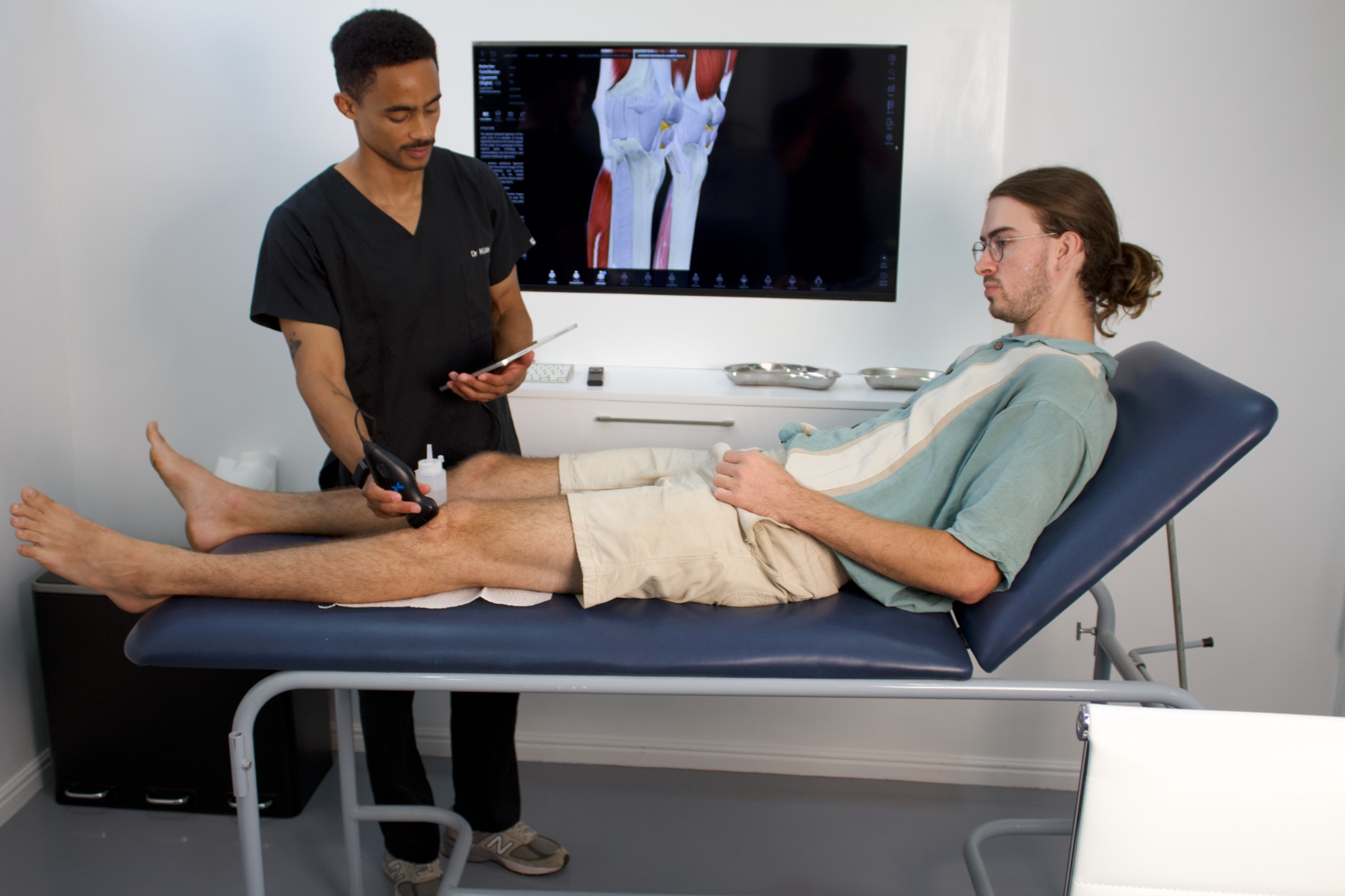
At Fluid Medical, sports consultations can include assessment of the injury, training load, movement and injury patterns, with imaging reviewed or requested where appropriate.
Management may involve rehabilitation guidance, activity modification or referral to another healthcare professional when needed. The aim is to understand what is injured and what needs to happen before you return to your usual training.
How Do You Know When It Is Safe to Run Again?
The absence of pain while sitting at your desk is not automatic clearance for a long run.
Returning after sports and exercise-related injuries should usually be gradual. Depending on the injury, you may first need to tolerate normal daily activities comfortably before progressing to more demanding exercise.
When you do return, resist the urge to make up for "lost" kilometres immediately. Your cardiovascular fitness might feel ready before the recovering area is prepared for the same workload you were doing before the injury.
Start conservatively. Pay attention during the run, later that day and the following morning. If symptoms return or increase as your running load goes up, that is useful feedback, not something to ignore.
Can Running Injuries Be Prevented?
Not every injury can be avoided, but your training habits matter.
Sudden changes in distance, frequency or intensity can increase the demands placed on the body. Recovery matters too. Rest days, adequate sleep, appropriate nutrition and strength work all play a role in helping your body cope with training.
Most importantly, do not wait until an ache becomes impossible to ignore. Early changes to your training may be much easier to manage than sports and exercise-related injuries that have been repeatedly aggravated for weeks.
Your Strava streak will survive.
Listen to the Niggle Before It Starts Shouting
Runners become very good at negotiating with themselves. "It only hurts uphill." "It goes away after 3 km." "I have a race next month." Sound familiar?
Sometimes rest is exactly what you need. Sometimes persistent pain needs a closer look.
If you are dealing with sports and exercise-related injuries or recurring pain when running, Fluid Medical offers doctor-led sports consultations in Cape Town to assess injuries and guide an appropriate return to activity.
Do not make "let us see what happens after another 20 km" your treatment plan. If something does not feel right, book a consultation with Fluid Medical and get it assessed.
Article Author

.svg)
.svg)
.svg)